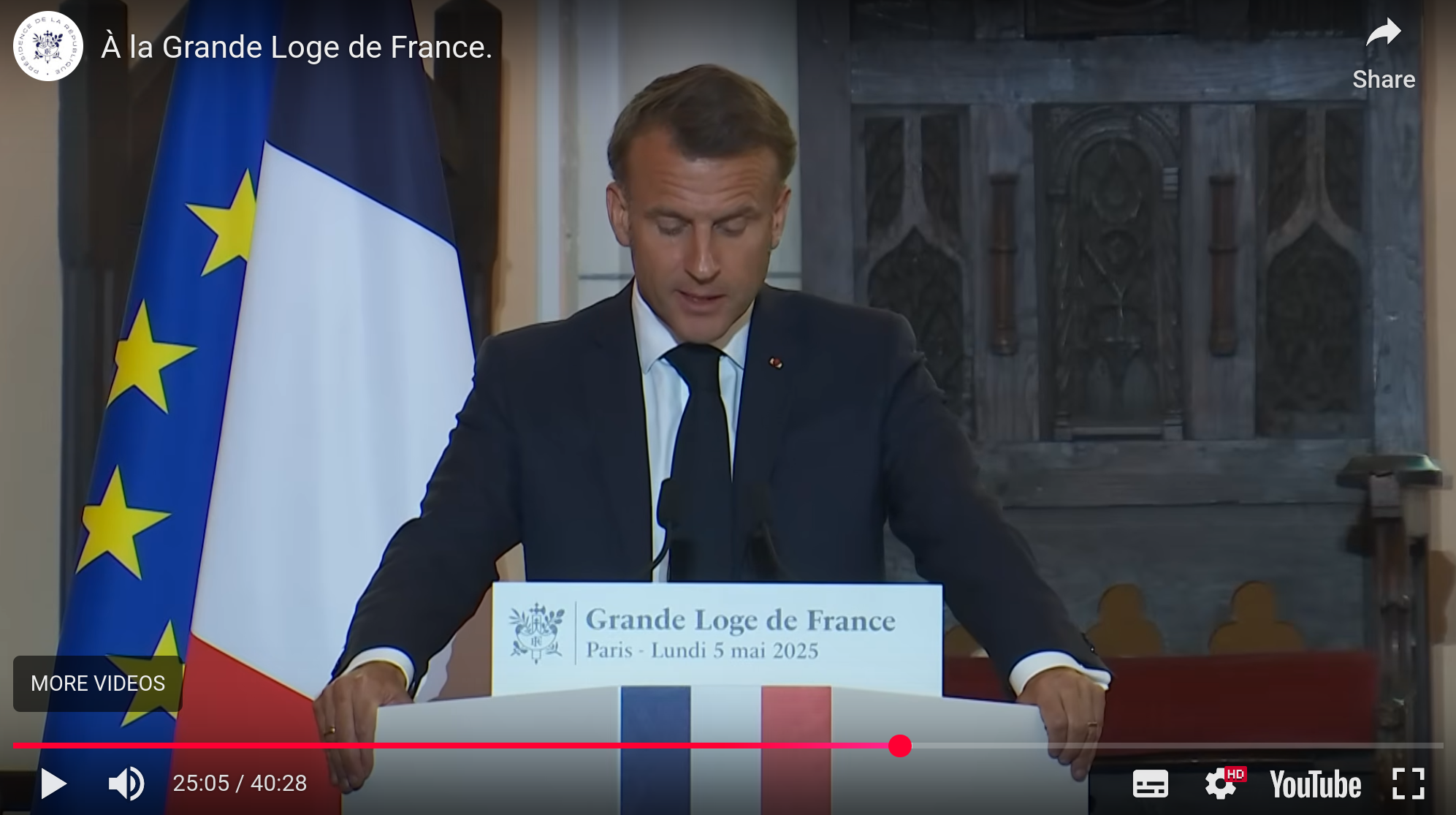
Editor: Macron chose to speak at a Masonic Grand Lodge to discuss how masons are at the tip of the spear of eugenics and democide (ie euthanasia).
Mr. Prefect of the region, ladies and gentlemen, elected representatives, ladies and gentlemen in your ranks and qualities.
I’m glad to be here today. And I have just, in a way, heard the perfect synthesis of all these reasons to be happy, I will try to come back to it. One of them is probably that, as you have recalled, and this is a form of incongruity, this is the first time that a President of the Republic has visited you, responding to your invitation. And I thank you very warmly, as well as for the words you have just spoken. This, first of all, because the dialogue between the Republic and Freemasonry is a conversation polished by centuries of struggle, by the communion of thought and by a collusion that is not a conspiracy. Freemasons, whose birth is contemporary with the emergence of the spirit of the Enlightenment, are all-natural children. And with them, with you, emerged this republican idea on which I will return, and you recall moreover this anteriority of the republican triptych at the very choice made by the Third Republic, long after, in your own texts: Freedom, Equality, Fraternity.
Freedom, first of all, that of the public use of reason to make science triumph, to advance progress in society. Equality is first of all that of rights, which is universal, common to the human race, revolutionary equality, proclaimed by the declaration of 1789. Fraternity, of course, and this beautiful word resonates with a particular weight, I am aware of it, in this Temple. While Freemasonry was the workshop of the Republic, in a way, it is a historical fact. I called him back to your brothers and sisters in the Grand Orient in November 2023. Indeed, throughout the 19th century, the republican idea was transmitted, protected in lodges when it was repressed, threatened, combated or repressed elsewhere. She survived because Masters and apprentices all rose to build the Republican building.
So, I know that taking a place here, in this setting, in this forest of symbols of which the poet spoke, will feed some comments. You’re used to it, I think I’m too. But I know that here you will not confuse the comments of the after with the verb of the beginning. This verb that has led you all to be present here, in this Great Temple, where the symbolic presence of those who have preceded you is mixed with your visible presence, as long as it is known to raise one’s gaze towards the light. Presence of Pierre Brossolette, the socialist and the resistant who preferred to give his life rather than lose comrades, his cause and his honor, who gave his life to France and also offers his name to this Temple where we are. Presence of Gustave Mesureur, first president of the radical socialist party, in which were drawn up some of the most important plans in our French history of progress. Presence of these faces that embody the motto of the Republic, a motto that is also yours: Freedom, Equality, Fraternity.
And freedom here has the face of Pierre Simon, this doctor who was also your Grand Master, whom you convened just now, and who has done so much to advance freedom: freedom of women, thanks to contraception first, the right to abortion afterwards, in favor of which he committed himself alongside Simone Veil. Equality has the face of the communian brothers of the Lodge of Justice who embodies with Jules Vallès this promise of equality at the heart of the Republic. Equality between men, between genders, between conditions. Equality as an instrument of liberation from tyranny, privileges, assignments as superstitions. And the brotherhood has the face of Hubert Germain, the last of the companions to have left us, whose gaze always burned alive with hope in humanity. The brotherhood also has the face of Arnaud Beltrame, whose love of neighbor drew its source, if I may say, in so many spiritual origins, his families of thought and hope which composed in him such a high conception of man that it led him to the point of sacrifice. These are all these names that I quote among others and that form under the high vaults of the Temple Pierre Brossolette a heroic company, a French fraternity. At the evocation of these names arise from the destinies, from the values, the history of the construction of the republican edifice, which was also made here, between these pillars and the luminous shadows that inhabit them. All this history shows that the Republic in Freemasonry is more than at home. She is in her home and in her heart. And to all these names too, perhaps you will allow me to add a more heterodox, that of Professor Choron, because it was the adventure of Charlie Hebdo and Hara-Kiri who were and remain places of this French spirit. Our French spirit, which also lizards by laughter, dogmas, insolence and blasphemy the powers and fanaticisms.
This is the first reason for my presence here, in this great lodge which is also found, I believe, in relation to the other obediences, in a particular place, perhaps kneaded with the same spirit of freedom that I evoked, for the search for freedom is too serious to be entrusted to brothers who would be only serious. It is also a matter of irreverence. Didn’t Brother Montesquieu himself have fun calling “the pastor of the needleworkers” one of the founders of Freemasonry, “Great Beelzebub of all the Masons”? So talking before you and through you, deep down to the entire nation, is all the more necessary as Freemasonry is at the forefront of the battle, the battle that matters if we want to shape the century for the good of humanity. A sign is undoubtedly the fact that Freemasonry has always been the target of the plotters, the obscurantists, who attribute to it an influence thus putting it in the spotlight. A press organ recently tried to influence the debates on the end of life, using an iconography that was forgotten since Vichy.
I’m telling you here, be proud of it. That, like other great spiritual families, the Freemasons take over this fundamental debate, the end of life, I also say here, is a good thing. I have no plans on this to be too long. And you’ve worked, I know, for a long time on this one. I have received your texts and I want to thank you for it. I also read everything that is written or said on this subject. This is not a subject. It is a vertigo that affects each and every one of us. But the debate can not be resolutely reduced to the question of whether one is for life or against life, or whether, on the one hand, there would be a humanism that would want treatment and, on the other, abandonment to death, simply. No. No. As you have asked, this is the question of the relationship to death, suffering and human dignity until the last second. And I’m afraid that sometimes, in our debates, things will rush, that forget the thickness and the great difficulty, sometimes, too, to just think the least evil. For in the face of certain situations, there is no longer good on one side and evil on the other, but simply to choose, in concrete situations, in the solitude of the one who has to die, from his family, his doctor, the singular path that respects at every moment the dignity of each one.
That the Freemasons bear this ambition to make man the measure of the world, the free actor of his life, from birth to death, who can be surprised? For my part, I welcome this, because the more the debate for the nation will be to this degree of intensity and elevation, the more the choice of the French will be enlightened and the consensus broad. But I was referring to these attacks against you, they are not new. They also participate in the same air of the time when the impulses of hatred, the anti-Semitic rage, the fury of the algorithms are exhibited. Through Freemasonry, at bottom, is the project of revolution and emancipation of which you are, with others, the guardians. Indeed, today is articulated a project born in the United States, but which will try to try to doubt it here, in Europe and France, this explicit project of the Black Enlightenment that tries to erase the legacy of at least 3 centuries of human progress. To the freedom of men, these black lights want to oppose the strength of things, to the equality of births, the hierarchy of conditions, to universal brotherhood, to the reign of wars and predations. This ideological project, it exists, and through women and men, it intends to govern. It is added to all the enemies of the Enlightenment who, since this movement of consciousness and knowledge exist, oppose it. I think of the ideologies of hatred that want to separate because of the origin, the gender, the religion, and that, in this, in this attack these pillars of reason and republican thought, of all those who consciously or not follow these ideologies, who take action, who raise their hands, who assault, strike, even kill because of these abhorrent impulses and these mobiles. So here, in this Temple, before you who know the power of the verb, to initiate the concord necessary for the establishment of the universal harmony that you call for, I mean the strength of the Republic, the strength of those who believe in it, and especially the strength of our secularism.
With you and among you, I wish to talk to you about what will occupy us at the end of this year: the commemoration of the 120th anniversary of the separation law of 9 December 1905. And remind us of simple truths that too often the public debate erases. The 1905 law is not an edict of tolerance, it is a law of freedom. It is a law that recognizes and protects freedom of conscience, freedom of worship but also freedom to abstain from any religious practice, freedom to believe and not to believe, freedom to pray, to philosophize, freedom of dogma, freedom of the mind. The 1905 Act is the Law of Fundamental Rights of the Human Being. And the Republic has the duty to allow everyone, in conscience, to think and express his point of view in all the spheres of his existence, in intimacy, it goes without saying, but also in the public sphere, it goes without saying also, provided that we impose the same duty as that imposed by the Republic, respect and respect the rights of the other, as well as we demand full respect for the rights that we recognize. Thus, whatever these beliefs may be, everyone can recognize themselves in the Republic, in freedom, equality and brotherhood. Thus we are faithful to the teaching of Aristide Briand: the law must protect the faith as long as faith does not claim to say the law. And within this secular public space, no one is identified, no one is assigned, no one is chained to a political, religious, social or cultural identity. It is a space where each of us recognizes the other as his brother in the Republic.
The 1905 Act, in this regard, finalizes and complements the Declaration of the Rights of Man and of the Citizen. Fraternity is not an identity, but an affinity. The brotherly path is the surest way to access the universal. And I think that here, in this chamber where each of you is looking for the paths that are traced to him, no one can really doubt it. That is why, in this year of commemoration of the 1905 separation law, as I have already asked the leaders of the cults, I ask you to be ambassadors of the brotherhood. This is how we will collectively demonstrate that the 1905 law is not an exclusionary law, but a meeting. Your obedience, if I may say so, has long been converted to this point of view. I know that you welcome among you and that you recognize as such brothers from all religious backgrounds: Catholics, Protestants, Jews, Muslims, but also free thinkers, agnostics, atheists, just as you welcome in brotherhood all those who come from political, social, cultural backgrounds, provided that each of them seeks in the Brotherhood, Freedom and Equality, the universal harmony, without it. Ambassador of goodwill of brotherhood, therefore of secularism, I ask you to go everywhere to repeat, constantly and without getting tired, that the only word that agrees with that of secularism is the word of freedom. Yes, secularism is freedom, freedom is secularism, they are inseparable, inseparable. Like Briand, I ask you to be faithful to the teaching of Jaurès, I quote: “the law of separation is not the victory of a group over other groups, but the common work and the common honor of all the Republicans” In truth, the republican state is not intended to secularize society. It is not his vocation or his function. And it is in this spirit that we must commemorate the law of 1905 and beyond, make it live.
Let us beware in this respect, in the trap that those who would like to make the 1905 law a reading of identity under the pretext of secularizing society, for the sole purpose of attacking religions or beliefs, especially in the name of their alleged incompatibility with the values of the Republic. This reading cannot be that of the Republic faithful to the universalism of the Enlightenment and to the spirit of 1789. Let us keep as much of those who intend to make secularism an instrument of repentance against the Republic, those who target the excesses of 1793 to attack the legacy of 1789, the foundation of our republican history. The law of separation protects us from all those who claim to inscribe in the Constitution prescriptions for identity in the name of an unequivocal reading of the past. Lay France is the natural daughter of the Republic, the fruit of this absolute demand for freedom which is so French and, dare I say, which begins before the Revolution. And that fidelity is also to be thought of.
In this Temple, in this house of freedom, I wished to reaffirm this. Then, bear this ambition constantly, others before you that I have quoted were ambassadors of brotherhood, carrying with it secularism. They were ambassadors by study, as you are in your work, but they were resolutely fighting for human progress. They were the face uncovered and in the arena. Deep down, fear nothing but renunciation, do not succumb to any fear, no shame, no temptation to erase. Be the vigices of this great law of 1905, like those who want to erase, betray or turn it away. This law is not 120 years old, it is from yesterday, it is today. It is more than ever tomorrow because it is imbued with that ever-living force of women and men of good will, without any other distinction. In the course of the centuries-old bond that binds the republican idea to the strength of Freemasonry, let us therefore make live this happy companionship, without confusing anything, without concealing anything. Then the Republic will live and secularism with it. But beyond that, be aware every day of the important role you play in our Republic.
For in the times we live in, and we evoked it at the moment together, so many of our fellow citizens, our fellow citizens, are plunged into an intimacy that no longer exists and open in some way to all the winds by social networks, intimacy upset by the algorithms that sometimes think for us and in this way divert our minds, and are plunged in front of a multitude summoned at every moment, Re-distinguishing the intimate of the collective is indispensable, but building the common in our societies requires indeed to listen, to understand, to doubt, to exchange and, in doing so, to continue the path which is that of the Republic and, before him, I believe very deeply, that of the French nation, which is precisely the path of progress on a human scale. Very Respectable Grand Masters and all of you here, under these columns, I believe that I have said, Long live the Republic and long live France.